

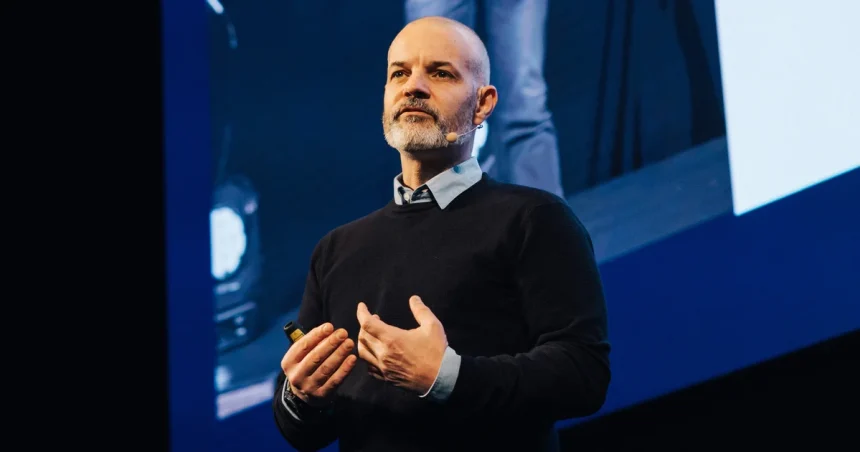
“The macroeconomics are shifting,” says Joost van Dreunen, as we discuss the seismic changes the games industry has seen over the past few years. “There’s a lot of big problems for both consumers and for people working in the industry.”
Van Dreunen co-founded the market intelligence firm SuperData Research back in 2010, and has been a professor at the NYU Stern School of Business for the past decade or so, as well as working as an advisor, analyst, author, and CEO of the data insight firm Aldora. Most recently, he became a strategic advisor for the community development agency ELO, and he’s also behind the well-respected Superjoost Playlist newsletter.
In a wide-ranging conversation, van Dreunen offered GamesIndustry.biz his thoughts on the problems facing the industry, including the issues with esports, the lack of connection between industry and education, and what the future for AI looks like.
Maybe we should talk about ELO first. How did you end up working with them?
Wouter Sleijffers and I worked together years ago. He really went both feet in on esports, and then from there, doing ELO. So my relationship with him is sort of longstanding.
I was immediately excited because it’s in line with a lot of the challenges and opportunities that I see: ELO proposes to basically create value for the community of the games industry, of esports fans, and so on, as opposed to having more of a tech-centric vision of the world, where the latest and greatest toy is going to be the best and the most interesting. It turns out that’s not the case. What people really seem to pull towards is their connection with others.
Speaking of the esports sector, we saw a huge amount of investment in it, but that seems to have cooled off. Do you think it’s going to recover?
A decade ago, esports came up hot and heavy, and then it didn’t get past a certain threshold for some reason. It took five to 10 years for the industry to reach a sort of mainstream level or critical mass where it became okay to go to these events and to make that part of your routine.
League of Legends, when they do their championship, it rivals the Olympics in terms of opening ceremony and spectacle, and then there is a whole bunch of scattered activity that never really matures past a sort of amateur level, or it stays small because it’s too niche.
On the one hand, people have always watched other people play video games. I think what’s happened is that the industry is starting to facilitate that better, in a more meaningful way. At the same time, as entertainment becomes increasingly digital and online, there’s inevitably going to be a counter-movement towards analogue, in-person experiences. If you look at Gen Z, box office attendance for that age range is up: in fact it’s higher than some of the other generations out there.
There is this natural cultural balancing between digital entertainment and physical in-person entertainment, and that’s why we’re seeing esports regaining a lot of its momentum from a few years ago.
So the idea of being in a room with other people is appealing?
Yeah, exactly. And the thing is that sports and play tend to have somewhat of a ritualistic or ceremonial component. Like the Super Bowl: it’s this annual event, and the teams don’t really matter and the score doesn’t really matter for most of the people that are watching it. It’s like a World Cup event or the Olympics. Do you remember the Olympic champions from three Olympic games ago? No, you don’t. But you remember watching it.
Gaming fits that same experience and I think it’s starting to reach that threshold where now we start to see how relevant it is in a broader entertainment spectrum, and it becomes funded accordingly.
But are we lacking games that really appeal to a wide audience, though? I was watching the Fortnite championships recently, and it was incredibly hard to work out what was going on for much of the time. I wonder whether that is a problem with esports: that they are obviously very exciting for people who intimately know the games, but for more casual viewers who might be watching esports at the Olympics, say, they’re quite difficult to parse and understand.
I think it is just like everything else: When I watch curling, I spend quite a bit of time just trying to figure out what the rules are. Half of it is trying to understand this little subculture.
It is a bit like rock and roll music or maybe punk music back in the day, where in the same way that a musical genre can define a generation, I think here we have a type of entertainment that is exclusionary in some ways, right? It deliberately almost excludes people that don’t belong to that group. But if you’re in the group, then it makes a lot of sense.
And in the same way with the Super Bowl, it doesn’t really matter what happens on the screen, not really. You spend most of your time interacting with the other people in the audience with you. So I think that makes esports not unique at all. It makes it the same as every other form of play.
Reflecting on the recent purchase of EA by private equity, that seems to suggest a maturity in the industry, where we now have stable returns from annual and evergreen blockbusters. Do you think the deal is a vote of confidence in the industry?
Gaming used to be on the fringes, used to be this underdog in terms of cultural relevance, and it’s come much more to the foreground now. As a result, you see the financial models mature a little bit.
There are games that are set up to be these lifelong journeys: It’s not about spending five years in secret building some amazing game and hoping you sell many copies. You’re now establishing a relationship with an audience over an extended period of time. And that’s something that historically has only been reserved for things like Pokémon and Dungeons & Dragons, where you eventually get to a point where parents start teaching their game to their children.
So the games industry in that sense is also maturing: it’s beginning to produce its own Mickey Mice. But there’s still a lot of things missing in terms of on-ramps.
So what’s missing?
There’s no clear on-ramp from an academic environment to a professional environment. Too few publishers and game companies are sourcing from game design programmes. I have too many students that find that they’re enamoured with video games and want to combine it with their degree in finance, marketing, fashion, whatever, and then say, “I don’t know where to go.” So there’s no clear on-ramp, where that is not the case for other forms of entertainment, media, or tech.
Another example is labour. As an entertainment industry, at least in the US, it is kind of weird that you have film and music and all these other places where creatives are protected by unions, and the games industry just doesn’t have the same safeties and the same security. So those are components that are still clearly missing, but they are changing as we speak, because the industry at large is maturing.
What needs to change about the route from education into games?
Universities could do a lot better when it comes to offering programmes, incubators, or connections, like inviting a bunch of publishers to come do a meet and greet with students that have an interest in coming to work for EA, Take-Two, Ubisoft, or any of the smaller companies. There still seems to be this ingrained disconnect between the creatives that sit in one part of the campus and the business school people.
And there’s nothing coming from the other end. The industry is not coming halfway towards them in any capacity.
At some point it is in the interest of the industry to have a close relationship with the academic institutions that are training their next generation of creatives, thinkers, strategists, and investors. And so the lack of involvement in those programmes, I put the responsibility on the industry.
It seems like the big companies at the moment are more preoccupied with laying people off rather than taking people on.
That’s true. They’re laying people off, in some cases thousands at a time. But are people going to stop playing? No. Demand for games will continue to grow over time. Just because the music industry has a bad year, it doesn’t mean people stop singing and dancing. So play will continue to drive demand over time.
And in a few years, we’re going to see all these big companies that have been so brave to lay off all these workers rehiring a whole bunch of people at a higher cost, because suddenly they’ll realise they now have a labour shortage. It’s only if you accept the idea that the games industry is going to go into some fundamental and continuous decline that you won’t need a new generation of people to come make games for you.
But there is a worry that people are starting to spend less on games, particularly with the increasing rise of free-to-play titles.
Sure, the abundance of content has become both an opportunity and a challenge, right? You could draw a parallel here with the 1950s in Hollywood, where you had these big productions and movie stars, and it was a spectacle business. And then in the 1960s, television popularised this low-brow, low-cost form of entertainment.
In my mind, the games industry is currently going through a contracted but similar transition: we’ve been building these castles in the sky, these amazing productions. The GTAs and the Call of Duties are these fantastic achievements culturally, technologically, and economically, and they have their own revenue model. And then over time, here comes Candy Crush, here comes some kind of swipe-three thing, and it feels very low-brow relative to what we’ve been doing, and the revenue model is different. A daytime TV show monetises very differently than a big blockbuster production at the box office.
So in that sense, it is evolving the landscape, and with it challenging the existing revenue model. So is that bad? Yeah, it’s tough for companies to make that turnaround. Are there a growing number of exceptions to this? Absolutely. The success of a Balatro, a Silksong: These are all games that shouldn’t really exist. They don’t make rational sense financially, and yet somehow they are deeply loved and commercially very viable and popular.
Most of the major companies that used to run the industry are now either absorbed or gone altogether. In slow motion, we’re seeing this turnover in how games are made, monetised, and consumed. Is that bad for workers? Of course, because there’s always going to be layoffs and some kind of correction. But it is also this inevitable change. Now that games are this big, the underlying economics shifts dramatically.
I want to finish off by talking a little bit about AI, and I’m particularly intrigued about what your students think about it at NYU. What’s their attitude towards AI, particularly in terms of games?
The makeup of my classroom is, say, 60% business school students, then I have about 20% technical or computer science students, or people with some kind of practical engineering type background, and then there are people that study media or culture. The engineering ones are really the group that embraces it the most, because they see the opportunity to catalyse their creative visions, to build it bigger and faster than they could otherwise. So they’re very open to it. The business school students, they are a little bit more hesitant.
In terms of games, what all three groups tend to agree on is that nobody wants AI slop. They see it as something that’s funny and interesting, but also something that is a consumable, something that you throw away immediately after consumption. They don’t attribute the same value to it as things that are organically created or human-built. They do see the value in terms of reproducing administrative components and using it as a tool set, but not so much as a final product.
I wonder whether we’ll see a dichotomy here, where people might engage with AI as a form of disposable gaming for a short while, happy to spend a few minutes laughing at some AI-generated Spongebob in Roblox, for example, but when they want to play a premium, high-quality game, that’s where users would resist AI.
Oh, 100%. This is the same audience that likes to watch Christopher Nolan movies and hates reality TV. Technology will come and go: we could talk about VR, we could talk about the metaverse, we could talk about crypto. While uniquely different in some ways, they have a few things in common, and one of them is that they always promise to be this next big solution. And I just disagree. It’s just historically incorrect. That’s just not the case. It creates opportunities, sure, but it is rare that these moments are so disruptive that everyone is successful immediately.
I suppose the trouble though is that more people watch reality TV than watch Christopher Nolan movies.
I’m a big fan of the idea that low tech is a much more interesting design factor than high tech. I think, demonstrably, whenever new technology comes out, what studios tend to do is just increase the final product. They make it more complex, and therefore they negate the productivity gains. They end up having more characters with more dialogue instead of optimising and making their process cheaper or faster. So in that sense, eventually it becomes the cart before the horse, because now it’s not fun anymore.
A typical example is Web3 gaming. I get it! Digital items and digital ownership: I could see how that could be meaningful. And also, none of these games are any fun. You went so far down the technology road that you forgot to make an interesting game, or you forgot to make it meaningful to people.
I’m encouraged to see these low-brow, low-tech games emerge where people are playing with their friends. And I think that that’s part of what’s going to challenge the industry as they continue to push into these tech-heavy areas where they feel they can be dominant and build a moat – they’re going to lose out because people are not interested in this. I think increasingly it’s clear that what people want is a $20 Silksong game that’s challenging, but it doesn’t have to make my eyes bleed in order for me to want it. I think audiences speak very clearly on this.
This interview has been edited for length and clarity.
Via: gamesindustry.biz