





After sky-high sales through the COVID pandemic, growth in the games industry has dramatically levelled off over the past few years. But the big question is: Will that growth return? Or has the games industry now reached a state of maturity, where the market is essentially saturated? If the latter is the case, what will the future look like?
In this special feature, GamesIndustry.biz has put together two essays from industry leaders that explore opposing viewpoints. One argues that we’re in the midst of another cycle and growth is returning, while the other assumes that we’re now entering a post-growth phase.
The first essay is by Chris Petrovic, chief business officer and board chairman at the developer and publisher FunPlus, which is headquartered in Switzerland, but has studios in China, Spain, and Portugal. Petrovic expands on a talk he gave at the recent DevGAMM Madeira Games Summit, arguing that the games industry will continue to grow – but that growth is likely to come from different locations.
The second essay is by Dr Pejman Mirza-Babaei, dean of the School of Graduate and Postdoctoral Studies at Ontario Tech University, and author of The Game Designer’s Playbook: An Introduction to Game Interaction Design. Mirza-Babaei tackles the idea that the games industry might now be reaching maturity – and if that’s the case, we might have to redefine what success looks like.
Chris Petrovic: Growth will come from different places
-(1).jpg "The Big Question: Will the games industry grow or plateau?")
All business sectors go through a series of cycles throughout their history, and video games are no exception.
If we look back at the history of our industry – whether from its early beginnings over 50 years ago, going back 20–25 years, or even looking at how things have evolved more recently – we can all agree that we have experienced countless peaks and valleys. These have been driven by everything from technological, business model, and platform shifts to evolving consumer preferences on where they spend their time, attention, and money.
In 2002, PC gaming was declared dead – and then digital distribution and live service business models came along. In 2006, mobile game sales declined – and then smartphones, app stores, and free to play came along to massively expand the total addressable market. (As a counterpoint, over the past 5–8 years, mixed reality (AR and VR) has still not managed to live up to the hype – lesson learned.)
A series of seismic events in the early 2020s led us to where we are today: the COVID spike and eventual return to normal, Apple’s privacy changes, and the end of zero interest rate policies, leading to recessionary trends and lower valuations. We now have a more mature but still growing market (with estimates of an approximately 5% compound annual growth rate over the next few years) that will continue to be the largest sector of entertainment, driven by more evolutions in business models (cross-platform, direct-to-consumer), content (AI, user-generated content), and distribution (>30% global mobile game user penetration rate).
“Large-scale commercial success is increasingly coming from new and different parts of the world”
Chris Petrovic
Part of what has created the current feelings of discomfort about our industry’s growth is that large-scale commercial success is increasingly coming from new and different parts of the world compared with where success came from in the past. Previously, we talked a lot about gaming innovation, creativity, and commercial success coming from places like the United States, Canada, Germany, and Finland, and now we are increasingly talking about emerging game dev hubs like China, Turkey, Israel, and Vietnam. As our industry continues to reach more and more users around the world, it is inevitable that success will follow suit and will increasingly come from more and more places – the question for us is, how do we take advantage of this?
A related discomfort is the sense that as our industry matures, consumers will continue to spend more time playing fewer games, and that the majority of growth that we see in our industry will be consolidated across fewer companies. While this is generally true for all long-standing business sectors, the beauty of our industry is that the ebbs and flows of our history mentioned above have been driven by constant creative and technological innovation, combined with a deep desire to understand and deliver on consumer needs and preferences.
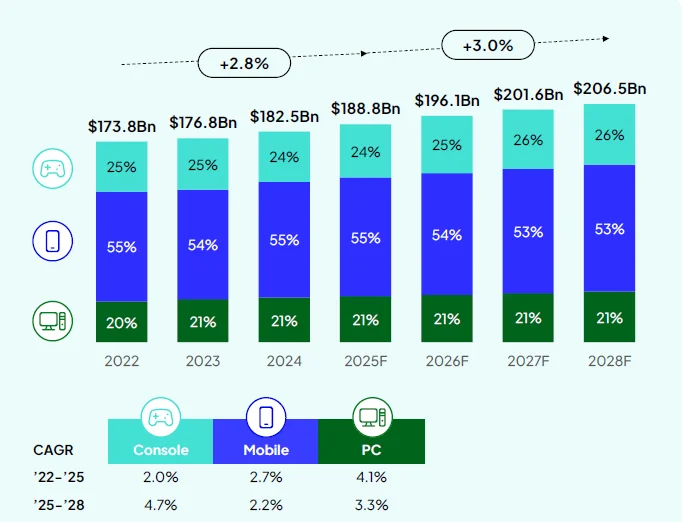
On this point, another question that is top of mind in our industry is trying to figure out the evolving preferences of our digital-native generations (Gen Z and Gen Alpha), as the competition for their time and attention is growing increasingly fierce. Whether it’s endemic sectors such as consoles, mobile devices, or ecosystems like Roblox and Fortnite, or adjacent sectors such as social platforms, e-commerce, streaming media, and IRL experiences, the reality is that consumers only have so much time and money to allocate to their regular habits and pursuits.
The good news for our industry is that gaming is more often than not a leading or primary source of entertainment and socialization for these younger generations. When they are not spending time in our games, they are increasingly interacting with game content and game IP in these other sectors, from watching ads to sharing gameplay videos to checking out the latest video game movie, TV show, or web series – our industry is uniquely positioned to continue holding its top place in the cultural zeitgeist.
As someone who has worked for over 20 years at the intersection of gaming, tech, and entertainment, I have no doubts that we are working in one of the most dynamic, innovative, and fast moving business sectors that exists today – and that will continue to exist and grow in the future for many decades to come.
Pejman Mirza-Babaei: If the boom is over, what does success look like now?
.JPG "The Big Question: Will the games industry grow or plateau?")
Will your game sell? Will it make enough money to satisfy investors? Will your studio survive another year? For decades, we have operated inside an economic model that expects constant growth, more players, more revenue, more titles, more everything. When that growth slows or stops, jobs disappear. For many developers, this fear never goes away.
And yet, despite these pressures, developers continue to make games with dedication and optimism. But perhaps that optimism can be something more than a coping strategy. It can also help us imagine a healthier future.
Today, many leaders believe the current downturn is temporary and that growth will return as it has in the past. That may be true. But there is another possibility: The games industry may be entering a mature, post-growth phase, where the old rules no longer apply. If so, we need to rethink what success looks like.
Post-growth economics argues that societies cannot depend on endless expansion. Growth might not be a good measure of well-being, and constant growth often comes with real societal and environmental costs. Instead, post-growth thinking asks: What if stability, sustainability, and quality of life were the goals instead?
This idea may sound far removed from game development, but the connection is surprisingly direct. Our industry often treats revenue curves the way nations treat GDP, as the only measure that truly counts. A profitable game is a “successful” game. Everything else is noise.
“Game development has many advantages in a mature or post-growth economy”
Pejman Mirza-Babaei
But this definition no longer fits the reality around us. Player attention is finite. Budgets are ballooning. Layoffs have hit every corner of the industry. New tech cycles, like live service, VR, the metaverse, or AI, no longer guarantee new growth. After 40 years of rapid expansion, we might be reaching a natural plateau.
If this is true, then the question becomes: How do we thrive in a world where growth is no longer guaranteed?
One hopeful truth is that game development has many advantages in a mature or post-growth economy: it relies more on creativity than on physical resources; it is already supported by public research and community-driven innovation (such as open-source tools, modding, and shared engines); and it has thousands of passionate workers motivated by meaning, not money. In other words, making games does not require exponential expansion to produce good outcomes. What it requires is stability, time, and care.
Imagine an industry that measures success not only by profit, but also by worker well-being, creative impact, fair labour practices, healthy communities, and ecological responsibility. These are not idealistic hopes. They are practical goals that many studios and many players already value.
To reach them, however, we must reconsider what we believe success looks like. Maslow’s hierarchy of needs offers a helpful lens here. If we look beyond financial growth, what do people in our industry truly seek?
- Safety. Stable jobs, predictable hours, health care, and time to rest. After years of crunch cycles and mass layoffs, this need is clearer than ever.
- Achievement. Game development is rewarding because you can see and feel your progress. Finishing a feature, hearing from players, or simply making something work creates real pride.
- Connection. Many of us join this field because we love games and want to share that passion. Communities, both inside studios and among players, give us a sense of belonging.
- Goodness. People want to feel their work does more good than harm. They want to avoid exploitative design, harmful labour practices, and toxic environments.
- Fulfilment. We create games because making things brings meaning and satisfaction. When developers have room to express ideas and build something they care about, the work feels worthwhile.
None of these needs require infinite growth. In fact, endless growth often makes them harder to achieve.
If we are entering a post-growth or steady-state phase, then we need better, more human-centred ways to define success. Here are a few to consider.
- Economic stability. Profit should support sustainability, not stretch teams to breaking in pursuit of bigger quarterly targets. A small, financially stable studio may be doing better than a giant hit factory that burns through people and money.
- Quality and craft. Praise from players, thoughtful criticism, and creative progress matter. Not every game needs mass-market appeal. Some of the most impactful works today are small, strange, personal, or niche.
- Personal and team development. Learning new skills, trying new ideas, and becoming better at your craft are forms of success that last much longer than sales spikes.
- Meaning and cultural impact. A game that resonates deeply, even with a small community, can have a cultural footprint far bigger than its revenue.
- Player communities. Building a kind, inclusive, healthy community is hard work. When it succeeds, it brings joy, purpose, and long-term value.
- Worker well-being. Decent hours, fair pay, reasonable expectations, and respect. These are not luxuries. They are the foundations of a sustainable industry.
- Environmental responsibility. Reducing waste, unnecessary merchandising, energy use, or harmful production practices. This contributes to both global sustainability and personal values.
These measures of success are human-centred, and they also make business sense in a world where growth is slowing.
If the games industry has reached maturity, it is not the end of opportunity. It is the beginning of choosing wisely. Changing how we define success means examining our own habits, values, and assumptions. It means recognizing that a profitable game is not the only success, and a slower year is not automatically a failure.
It also means facing fears. Shifting away from growth-first thinking is uncomfortable. Studios worry about being left behind. Workers fear speaking up. Change can feel risky when margins are tight. But the alternative, continuing to chase growth, creates even more uncertainty and instability.
The path through this moment is not simply to wait for growth to come back. It is to build an industry that can thrive even without it.
Talk with colleagues. Talk with players. Support unions. Push for kinder practices. Challenge reckless decisions. Make smaller, healthier scopes. Celebrate art and community, not just revenue. No one person can fix the system. But everyone can help shape what comes next.
If we can rethink success for a post-growth world, we may find ourselves creating not only better games, but also a better industry and a better future.
This essay is adapted from a longer article originally published in Interactions magazine, written by Samantha Stahlke, Tanner Mirrlees, and Pejman Mirza-Babaei. The original piece can be found here.
Via: gamesindustry.biz